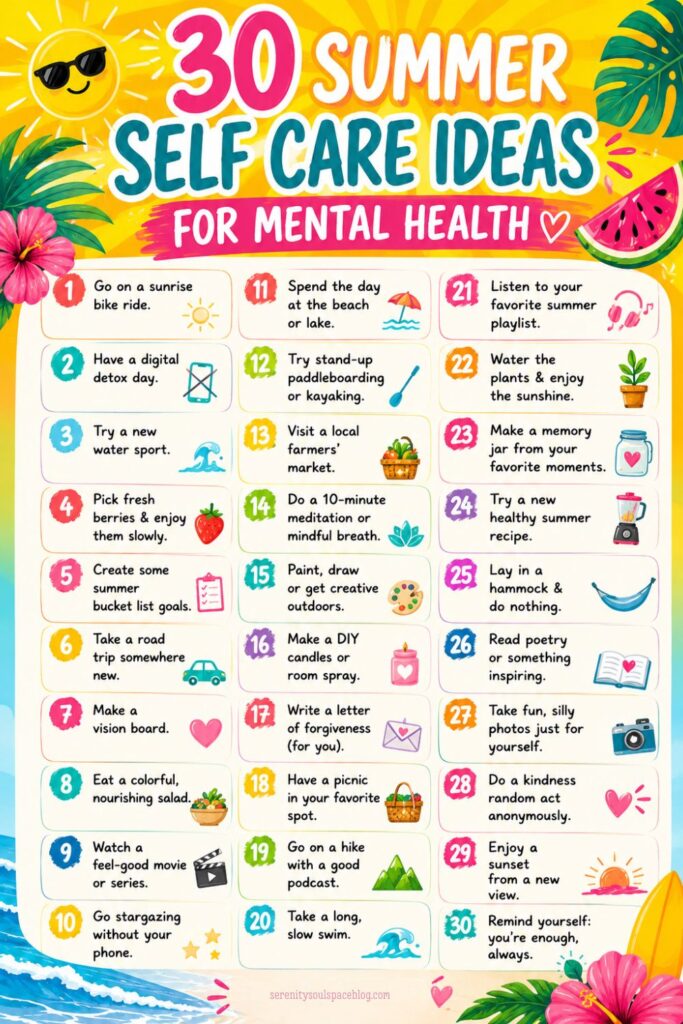
25 Ideas for Your Summer Self-Care Mental Health
This post contains affiliate links, meaning that as an Amazon associate, I may earn a small commission at no extra cost to you if you make a purchase through these links. For more details, please read our disclosure policy.
Something shifts when summer arrives. The days get longer, the pace slows down just enough, and somewhere in the back of your mind, you start thinking about what you actually want your life to feel like. Not just what you need to get done. What you want to feel.
Summer has a way of reminding you that you deserve more than survival mode, and if you’ve been running on empty, pushing through stress, and putting yourself last, this season is practically handing you an invitation to finally do something about it.
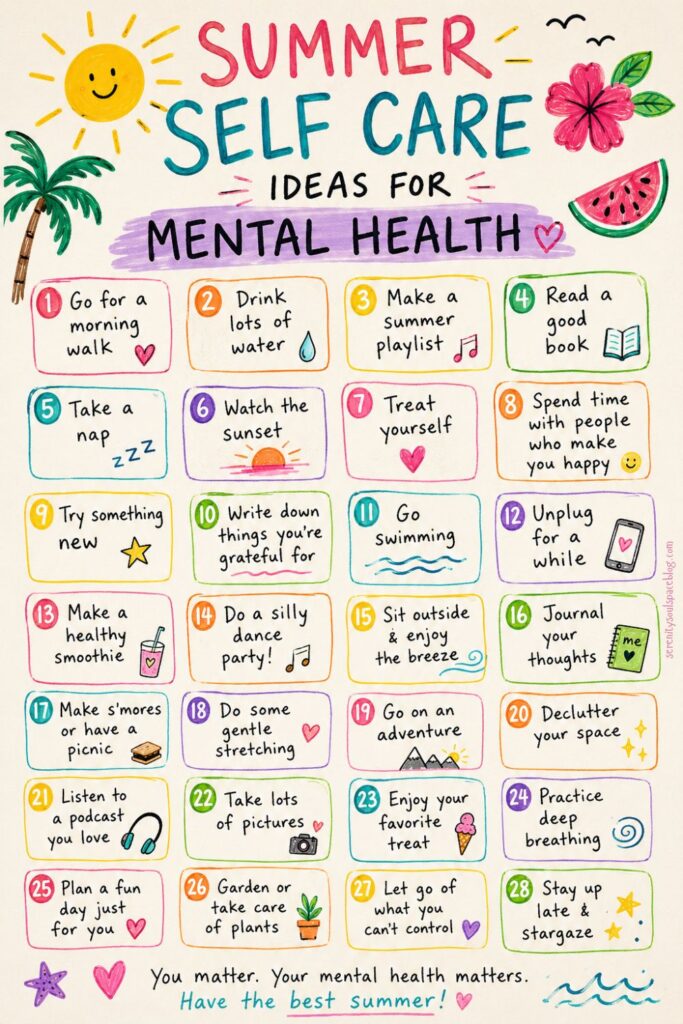
These 25 activities are simple, research-backed, and genuinely good for your mental health. Pick a few. Start small. Let this be the summer you actually show up for yourself.
1. Wake up with the sun at least once a week. Morning light isn’t just pretty. It helps regulate your body’s internal clock and supports serotonin production, which directly affects your mood. You don’t have to become a morning person overnight. Just step outside for ten minutes before the day gets loud and let the light do its job.
2. Swim. There is something about water that just works. Whether it’s a community pool, a lake, or the ocean, water-based movement reduces cortisol levels and has a calming effect on your nervous system that’s hard to explain until you’ve felt it. Even floating counts.
3. Write down three things you noticed today. Not three things you’re grateful for. Just three things you actually noticed like a color, a smell, or sound. Grounding yourself in sensory details pulls you out of anxious thought loops and brings you back to the present moment, which is where peace actually lives.
4. Spend 20 minutes in nature with your phone put away. Research consistently links time in natural environments to lower stress, reduced anxiety, and improved mood. The key word is “away.” Leave the phone inside and just be somewhere green for a little while.
5. Sign up for one community event. Outdoor concerts, neighborhood cookouts, free fitness classes in the park. Look up what’s happening near you this summer. Social connection is one of the strongest predictors of mental well-being, and summer makes it easier to find than almost any other season.
6. Create a wind-down ritual for summer evenings. A consistent nighttime routine signals your nervous system that it’s safe to rest. A short walk after dinner, herbal tea on the porch, a few pages of a good book. Find your signal and stick to it.
7. Try something you’ve never done before. Kayaking, pottery, a new hiking trail, salsa dancing. Novelty activates dopamine and builds a genuine sense of confidence. You don’t have to be good at it. Trying is the whole point.
8. Declutter one space in your home. Cluttered environments increase low-level stress even when you don’t consciously notice it. Pick one drawer, one shelf, or one corner. The relief you feel after is very real.
Related read…
◉ These 25 Reasons Are Why You’re Not Getting Your Life Together
9. Cook one meal using fresh, seasonal produce. What you eat has a direct relationship with how you feel mentally. Summer’s farmers markets and produce sections are full of ingredients that support brain health. Berries, leafy greens, tomatoes. Make one meal from scratch this week.
10. Call someone you’ve been meaning to call. A real call, not a text. Real-time voice connection strengthens relationships in ways that messaging just can’t, and loneliness is a genuine mental health risk. Pick one person and dial.
11. Let yourself be bored. Boredom is not a problem that needs solving. Unstructured time allows your brain to rest, consolidate memories, and recover from overstimulation. Resist the urge to fill every quiet moment with scrolling.
12. Start a summer journal. No prompts required, no plan needed. Write what happened, what you’re thinking about, what’s weighing on you. Expressive writing helps process emotions and reduces the kind of mental rumination that keeps you up at night.
13. Move your body in the evening. A gentle walk, some stretching on the porch, a light bike ride after dinner. Moving in the evening helps release physical tension that builds throughout the day and actually improves your sleep quality at night.
14. Read a physical book. Screen fatigue is real and most of us are drowning in it. Reading an actual book, especially fiction, gives your brain a different kind of engagement. It builds empathy, lowers stress, and requires the kind of focus that the internet actively trains out of us.
15. Do a social media audit. Spend a week noticing how you feel before and after you open each app. If a certain account consistently leaves you feeling worse about yourself or your life, unfollow it. Your feed is not neutral. It either adds to your mental health or takes from it.
16. Practice saying no to one thing this summer. Overcommitment quietly drains people and most of us never connect it to our mental health. Choose at least one invitation, obligation, or project to decline this season. Rest is maintenance.
17. Watch the sunset. This sounds too small to matter, but the research on awe is genuinely fascinating. Intentionally pausing to witness something beautiful with no task attached decreases self-focused thinking, reduces stress, and increases your sense of connection to something bigger than your to-do list.
18. Make a playlist that matches your actual mood. Music is one of the most accessible emotional regulation tools you have access to. Build a playlist for your real summer, not a curated version of it. Play it when you need to feel understood.
19. Spend time with an animal. If you have a pet, actually be present with them instead of scrolling while they sit next to you. If you don’t, volunteer at a local shelter or spend time with a friend who has one. Interactions with animals lower cortisol and increase oxytocin in ways that are well-documented and honestly kind of wonderful.
20. Protect your sleep, even in summer. Late sunsets and packed social calendars make summer sleep harder to guard. Chronic sleep deprivation is directly linked to increased anxiety, depression, and emotional dysregulation. Keep your bedtime as consistent as you can and treat it like the non-negotiable it actually is.
21. Do a body check-in. Sit quietly and scan from your head down to your feet. Where are you holding tension? Where do you feel tight or heavy? Your body holds emotional information your brain doesn’t always process consciously. Checking in regularly is a form of self-awareness most people skip entirely.
22. Spend an afternoon alone on purpose. Not because your schedule forced it, but because you chose it. Intentional solo time helps you reconnect with your own thoughts, preferences, and pace. There’s a difference between loneliness and solitude, and learning to sit comfortably with yourself is genuinely good for you.
23. Learn something just because you want to. A new language, a craft, how to identify local birds, a period of history you’ve always been curious about. Learning for pure pleasure, with no career goal attached, activates curiosity and intrinsic motivation, both of which are strongly associated with greater life satisfaction.
24. Have one honest conversation. With a friend, a family member, a therapist, or yourself in your journal. Authenticity in relationships is one of the most overlooked mental health protective factors. Say something true that you’ve been holding onto.
25. Get clear on what this summer actually needs to look like for you. Not what summer is supposed to look like. Not what everyone else seems to be doing. What do you need this season? More rest, more connection, more adventure, more stillness? Write it down and treat it like a real plan, because it is one.
You don’t have to work through this list from top to bottom. Pick two or three that feel right and start there. Mental health is a practice, and summer is one of the better seasons to build new ones.
The right products make the difference between a self-care list you read and one you actually use. Browse the full Amazon storefront here: Summer Self Care Ideas for Mental Health