
The Strange Reason You Feel Exhausted All the Time by Thursday
There’s a specific kind of tired that hits around Thursday afternoon, and it doesn’t feel like regular tiredness.
You’re not sick. You haven’t skipped sleep (well, maybe a little). You haven’t done anything dramatically different from what you do every other week.
But somewhere between Tuesday’s momentum and Thursday’s drag, something in you quietly ran out of fuel.
If you’ve been wondering why you feel exhausted all the time, especially by the later half of the week, you’re not imagining it, and you’re certainly not alone.
What most people don’t realize is that this particular exhaustion has very little to do with how many hours you slept or how physically demanding your days have been.
It’s something else entirely, and once you understand it, the relief that comes from simply knowing why is real.
Something Starts Catching Up With You Around Thursday
Monday tends to feel manageable. You might even start the week with a little momentum, a to-do list that feels conquerable, a cup of coffee that actually helps.
By Wednesday you’re still functioning, still keeping pace. But Thursday arrives differently. Something in the pace shifts, and what felt manageable earlier in the week suddenly requires more effort than it should.
What’s happening isn’t random. Every single day of a workweek demands something from you that goes far beyond physical effort.
Your brain is constantly processing, filtering, deciding, responding, adjusting, and carrying forward unresolved things from the day before. Each day adds another layer.
By Thursday, you’re not just dealing with Thursday. You’re dealing with Monday through Thursday all at once, even if nothing about your schedule technically reflects that.
Think about it this way: energy isn’t just a physical resource. Your ability to focus, stay patient, make decisions, regulate your emotions, and stay motivated all draw from the same reservoir.
When that reservoir gets depleted faster than it can refill, everything starts to feel heavier, sharper, more annoying, more impossible than it actually is.
You may have missed these related posts…
◉ 100 Thursday Morning Blessings and Prayers to Start Your Day With Intention
◉ 7 Things That Actually Help When You Feel Exhausted All the Time
Ordinary Tasks Begin Feeling Overwhelming
The Mental Price of Constant Decision-Making
Toward the end of the week, you’ve made hundreds of decisions, possibly thousands if you include the small, seemingly insignificant ones.
Your brain has been deciding what to eat, whether to respond to that email now or later, how to word a difficult message, whether to bring something up or let it go, and which task to tackle first when your list keeps growing.
Each of those decisions uses mental energy, and that energy doesn’t regenerate the way we’d like it to. Researchers call this decision fatigue, which is the gradual erosion of your ability to make clear, confident choices after a long string of decisions.
What feels like laziness or lack of motivation on Thursday afternoon is often your brain genuinely running low on the cognitive fuel it needs to navigate even simple choices.
This is why even small choices on Thursday: picking which task to tackle next, deciding whether a message is worth sending, figuring out what needs to happen before end of day, can feel like far more effort than they actually require.
The frustrating part is that this response looks like procrastination from the outside, or worse, feels like personal failure from the inside. But your brain is reacting exactly the way an overworked system would.

Your Emotional Buffer Gets Smaller
There’s also what happens to your emotional regulation as the week progresses. Early in the week, you have more capacity to handle interruptions, setbacks, or annoying situations with relative grace. Toward the end of the week, however, that capacity has shrunk considerably.
The same coworker who didn’t bother you on Monday might send you spiraling on Thursday. A small inconvenience that would’ve rolled off your back two days earlier can suddenly feel like an enormous problem.
This isn’t a character flaw. It’s a predictable outcome of carrying too much for too long without adequate recovery.
The Mental Load Nobody Talks About
Most conversations about exhaustion focus on what you’re doing. But a significant portion of what drains people by this point in the week comes from everything they’re holding, not everything they’re doing.
What’s actually draining you is everything you’re mentally carrying alongside the visible work: an unfinished conversation you’ve been postponing, a quiet awareness of someone else’s needs and stress, financial worry, work performance, or concerns about your health. None of this shows up on a to-do list, but all of it takes up space.
This is often called the mental load, and it’s the invisible weight that accumulates beneath everything you’re visibly doing.
For many people, especially those who manage households, caretake for others, or work in emotionally demanding roles, this load is constant. It doesn’t clock out at the end of the day, and it doesn’t take weekends off.
When Thursday hits, the mental load of the entire week is at its heaviest. And because so much of it is invisible, it’s also very easy to dismiss.
You might look at your schedule and think, “I didn’t even do that much this week.” But your nervous system has been carrying far more than your calendar shows.
Why Thursday Feels Like You Hit a Wall
You’d think that being so close to the weekend would make Thursday feel lighter. The logical part of your brain knows that Friday is almost here. But emotional and physical systems don’t operate on logic, and knowing relief is close doesn’t automatically produce relief.
Thursday sits in an awkward place in the week. The early-week energy has long faded, and the sense of accomplishment that comes with finishing hasn’t arrived yet.
You’re in the gap between having started and being done, which is often where the accumulated weight of the week becomes impossible to ignore.
Athletes describe something similar around mile eighteen of a marathon. You’ve been running long enough to be truly depleted, but the finish line isn’t close enough yet to carry you on adrenaline.

There’s also the accumulation of anything left undone from earlier in the week.
Unfinished tasks have a way of staying in the background of your mind, quietly consuming mental resources while you try to focus on other things.
By Thursday, the pile of unresolved things is usually at its peak, and the awareness that you now have only one day left to address them before the weekend can create its own low-grade pressure.
That pressure doesn’t feel dramatic. It rarely feels like stress in the traditional sense. Mostly it just feels like everything being a little harder than it should be.
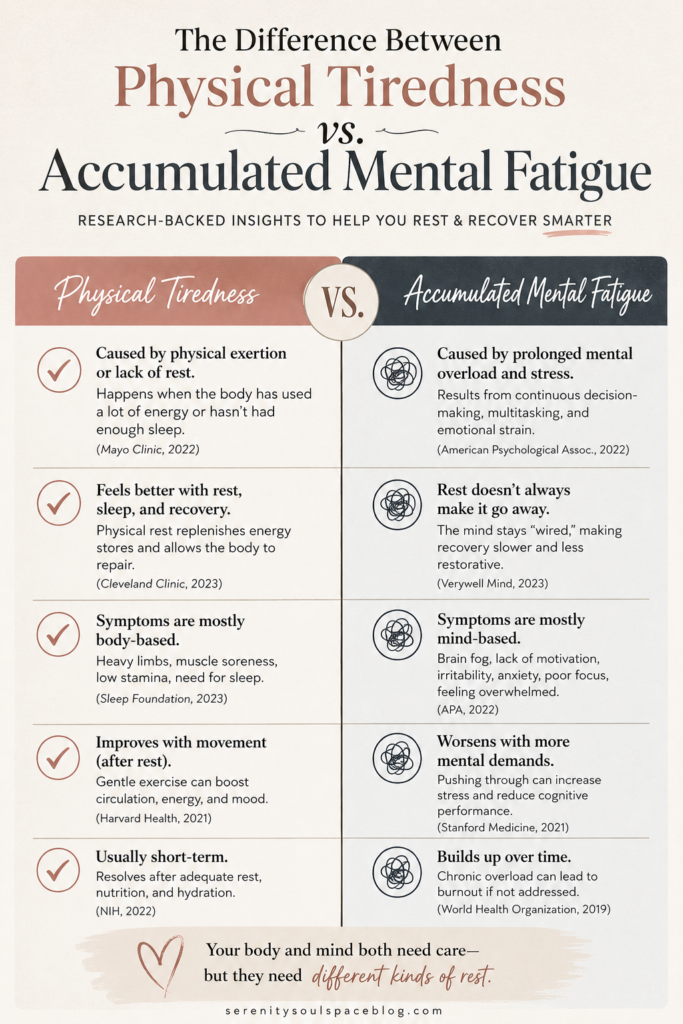
Physical Tiredness vs. Accumulated Mental Fatigue
These are genuinely different experiences, and understanding the difference matters because the solutions for one don’t always work for the other.
Physical tiredness responds fairly well to rest — you sleep, and your body recovers. Mental fatigue doesn’t work that way.
You can get a full eight hours and still wake up four days into the week feeling flat and unmotivated, because the exhaustion you’re carrying isn’t stored in your muscles.
It lives in your nervous system, your emotional reserves, and the cognitive capacity you’ve been drawing from all week.
Mental and emotional fatigue has a distinct feel to it. You find yourself putting more effort into things that normally come easily, including things you actually enjoy.
Irritability shows up without an obvious reason. Small decisions feel harder than they should. Your patience runs out faster than usual, and concentration slips even when you’re not the least bit sleepy.
The tasks and interactions that felt manageable on Monday start to feel like a lot by the time Thursday afternoon rolls around.
The instinct most people have is to push through and hope the weekend fixes it. Sometimes the weekend helps. But without intentional recovery, Monday has a way of arriving before the tank ever fully refills.
Creating Breathing Room Before Friday
You don’t need a complete life overhaul to feel better by Friday. Small shifts, made consistently, tend to do more than dramatic changes ever do, especially when you’re already running low.
Give yourself permission to do less on Thursday evenings. The tendency to push through and catch up on everything before the weekend is understandable, but piling more onto an already drained system usually backfires. A quieter Thursday evening is often better for your Friday than a productive one is.
Limit decisions where you can. If Thursday is consistently hard, think about what choices you can make in advance so that you’re not drawing on an empty reserve. Deciding a few things in advance on a calmer day means your “Thursday-self” doesn’t have to summon decision-making energy it no longer has.
Do something that requires nothing from you. Scrolling through your phone or watching something that requires you to follow a plot still asks something of your brain, even if it doesn’t feel like it.
What actually helps is something with no input requirements at all like a short walk, sitting outside, listening to music, a warm shower where your mind can go completely blank.
There’s a difference between entertainment and actual rest; and by the time Thursday rolls around ,your brain is usually asking for the latter.
Name what you’re carrying. There’s something genuinely relieving about getting everything out of your head and onto a page. Your brain uses mental energy just to hold onto unresolved things, and writing them down frees up that space in a way that’s hard to explain until you’ve actually tried it. Most people are surprised by how much better they feel after five minutes of just getting it all out.
Resist the urge to diagnose yourself as lazy or unmotivated. That inner critic voice on Thursday afternoon has bad timing and terrible instincts. Feeling depleted is not the same as failing, and treating yourself like you’ve done something wrong only makes it harder to recover.
The Feeling Makes More Sense Than You Think
Feeling exhausted all the time by Thursday isn’t a personal weakness, and it isn’t a sign that something is wrong with you. It’s a very human response to a genuinely demanding kind of week, one where the visible workload is only part of what you’re actually managing.
The people who seem to have it together on Thursday afternoons aren’t necessarily doing less. They’ve often just found ways to protect their energy more intentionally, or they’ve quietly given themselves permission to acknowledge when they’re running low without making it mean something about who they are.
You can do the same.
Most people move through the week without ever stopping to ask why Thursday feels the way it does. They just assume that everyone else handles it better and something must be off with them.
There is nothing wrong with you. Some weeks ask more of you, and Thursday is when your mind and body finally say so.
More Support for Your Path
◉ 100 Thursday Morning Blessings and Prayers to Start Your Day With Intention
◉ 7 Things That Actually Help When You Feel Exhausted All the Time








Leave a Reply
You must be logged in to post a comment.