
The Midweek Slump:
Why Your Mind and Body Need More Than Rest

You made it through Monday. Tuesday felt manageable. Then Wednesday arrived and something shifted. Your coffee stopped working. Your to-do list looked longer than it did at the start of the week, even though you have been checking things off. You sat down to work and just… stared. If that sounds familiar, you are not alone, and there is actually a real reason this keeps happening.
The midweek slump is one of those things people joke about without realizing how legitimate it is. There is a pattern here, and once you understand it, that heavy, foggy, what-is-even-happening feeling starts to make a lot more sense.
What Is the Midweek Slump, Exactly?
The midweek slump is that noticeable drop in energy, focus, and motivation that tends to hit somewhere around the middle of the week, usually Wednesday but sometimes bleeding into Tuesday afternoon or Thursday morning.
People often assume it is just sleepiness, but it runs deeper than that. It comes with mental fog, emotional flatness, or a general sense of being overwhelmed without a clear reason why.
What makes it frustrating is that it does not always look like a problem from the outside. You are still showing up and performing your duties. But internally, everything feels slower and harder than it did 48 hours ago.
That gap between what you are doing and how you are feeling is exactly what the midweek slump creates.
It happens partly because of how our brains track time and effort across a week. The beginning of the week carries a fresh-start energy, a psychological reset that helps push you forward.
By midweek, that reset has worn off, but the weekend finish line is still not close enough to feel motivating. You are stuck in the middle of the effort without the momentum of the beginning or the relief of the end.
The Signs You Are in a Midweek Slump
Some of these will feel obvious. Others might surprise you.
On the mental side, the slump often shows up as difficulty concentrating, trouble making even small decisions, forgetting things you would normally remember easily, or just staring at a task without being able to start it.
You might find yourself rereading the same sentence three times or opening a tab and immediately forgetting why. This is me all day every day.
Emotionally, it can feel like mild irritability, low mood, disconnection from things that usually bring you joy, or that vague sense of being overwhelmed and exhausted without a single dramatic cause you can point to.
Physically, the slump can feel like your body is running on fumes. You got enough sleep, but you still dragged yourself out of bed and have been dragging ever since.
Sugar cravings hit harder than usual, the caffeine does not seem to be doing its job, and comfort food starts sounding like a reasonable solution to a problem you cannot quite name.
Your body is hunting for a quick energy fix because its normal reserves are running low.
If you recognized yourself in more than a few of those, your Wednesday fog probably has very little to do with how much sleep you got and a lot more to do with everything you have been carrying.
📖 Your Next Read Awaits
◉ Why So Many Exhausted Adults Are Trying Weighted Blankets for the Midweek Slump
Why Sleep Alone Is Not Enough
Here is something a lot of people do not expect: you can sleep a full eight hours and still wake up Wednesday feeling like you never went to bed.
Sleep does an incredible job of restoring your body, but it does not touch what has been draining your mental and emotional reserves all week, and by midweek, those are usually the first things to go.
Think about how many decisions you quietly make in a single day: what to eat, how to word a sensitive email, how to handle something that came up at work, what to deal with now versus later.
That constant low-level processing pulls from a limited pool of mental energy, and by Wednesday you have been pulling from it for days. Your brain is genuinely tired in a way that feels nothing like needing more sleep.
Then add everything you have been carrying emotionally. Relationship tension, financial stress, managing other people’s moods, sitting with things you have not had time to fully process. None of that resets overnight, and all of it has been accumulating since Monday morning.

What Is Actually Feeding the Midweek Burnout
Decision Fatigue Is Real
Every decision you make throughout the day draws from the same limited pool of mental energy, and most people are making far more decisions than they realize.
By the time you have answered a dozen emails, navigated a tense conversation, figured out dinner, and kept your mental task list from completely unraveling, your brain has been running hard for hours.
Midweek burnout often starts here, with that slow, quiet depletion that does not announce itself until Wednesday when you are standing in front of the fridge genuinely unable to decide what you want and feeling oddly exhausted by the question.
Emotional Labor Nobody Talks About
If you are someone who takes care of other people, whether that is kids, aging parents, employees, clients, or the friend who always calls when something goes wrong, emotional labor is a real part of your daily output.
It takes empathy, patience, and a kind of sustained attention that costs energy even when the work feels meaningful. That cost does not show up on a calendar or a to-do list, which is exactly why it tends to catch people off guard by midweek.
The Mental Load
This one hits especially hard for anyone managing a household, a family, or a demanding job. The mental load is not just the tasks themselves. It is remembering the tasks, planning around them, anticipating what is coming next week, and making sure nothing gets dropped. It’s all the ACTION verbs, the actual DOING.
Think of it as a background tab or apps in your brain that have been open and running since Monday without a real break.
By Wednesday, they have been running long enough to start slowing everything else down.
Environmental and Lifestyle Factors
Artificial lighting all day, hours of screen time, skipping meals (or eating whatever is fastest), barely moving your body, spending the whole day reacting instead of ever getting ahead… none of these things is a crisis on its own.
But stack them together across several days and they quietly wear down your body and brain in ways that show up right around the middle of the week.
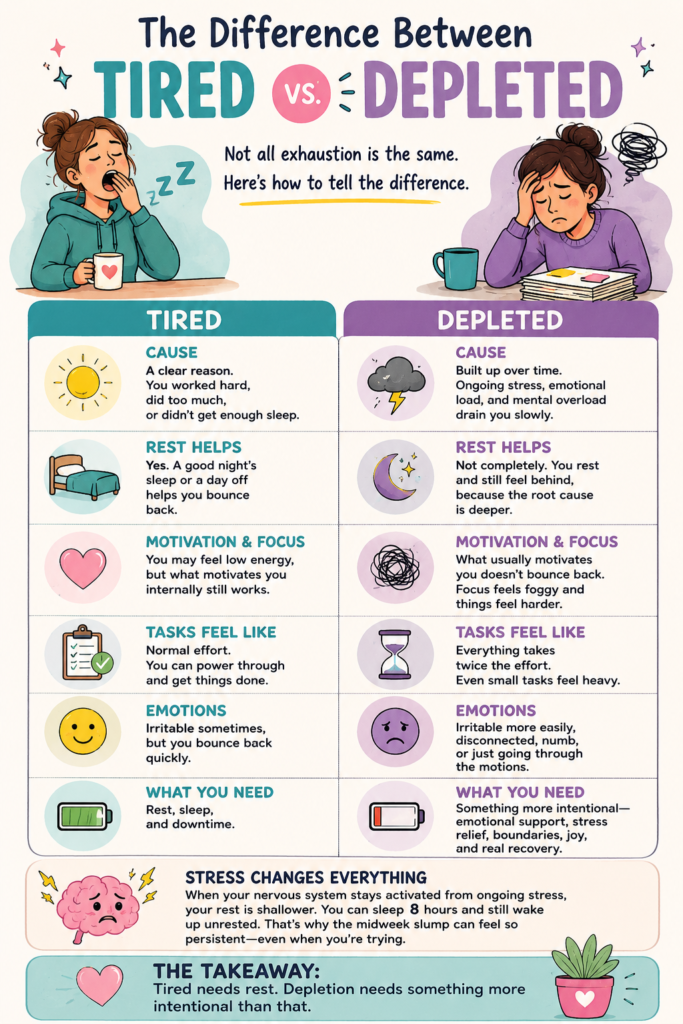
The Difference Between Tired and Depleted
Regular tiredness has a shape to it. You worked hard, rested, and returned. There is a clear cause and a fix that actually works.
Depletion, on the other hand, is a different experience altogether. You rest and still feel behind.
What normally motivates you internally does not bounce back the way it usually does. Tasks that would normally take you twenty minutes feel like they require twice the effort.
You might notice yourself getting irritated more easily, feeling disconnected from people you care about, or just going through the motions without much behind it.
That feeling sticks around because it is not coming from one thing, and one good night of sleep is not going to be enough to clear it.
What makes this harder is that stress actively works against recovery.
When your nervous system stays activated from ongoing stress, the sleep and rest you do get is shallower than it should be.
So you can sleep eight hours under a lot of pressure and still wake up unrested, which is why the midweek slump can feel so persistent even when you are genuinely trying to take care of yourself.
Tired needs rest. Depletion needs something more intentional than that.
How to Beat the Midweek Slump Without Overhauling Your Life
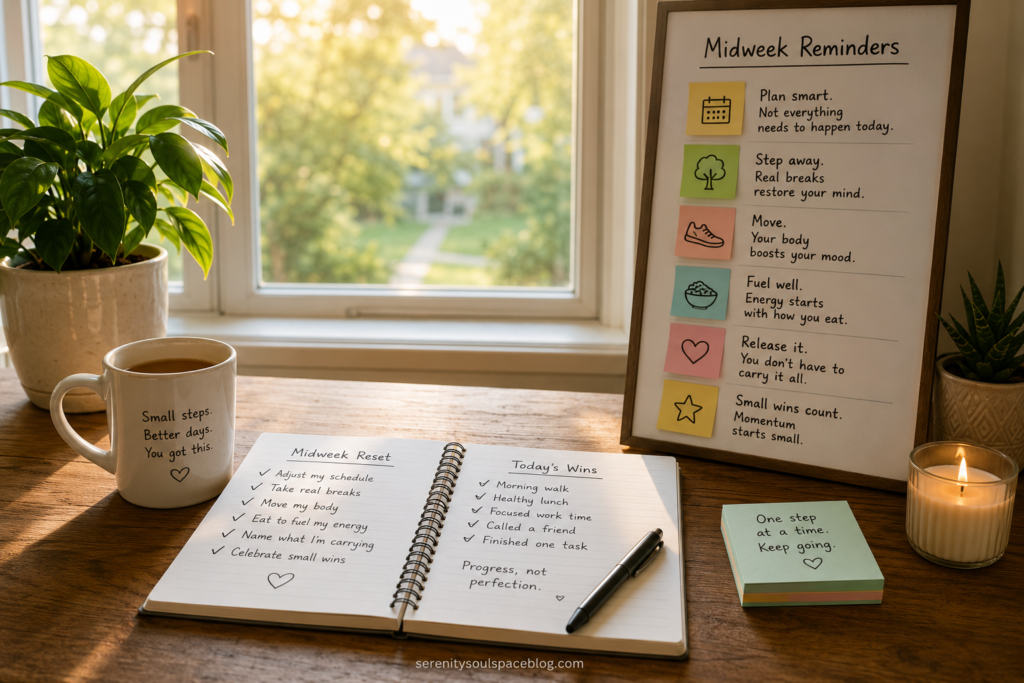
Adjust What You Schedule for Midweek
If you have any flexibility in your calendar at all, Wednesday is not the day for your hardest thinking or biggest decisions. Save that for Monday or Tuesday when your mental energy is still relatively fresh.
Midweek tends to be much better for routine tasks, lighter follow-ups, creative work that does not require a lot of pressure, or conversations that are more relational than strategic.
Working around your natural energy patterns rather than fighting them is just practical, and it makes a noticeable difference by the end of the day.
Take Real Breaks
Picking up your phone between tasks is not a break. Your brain stays just as activated scrolling as it does working, sometimes more so.
A real break means putting the screen down and stepping away, even for ten minutes.
Go outside if you can, or just sit somewhere quiet and let your mind wander without an agenda.
That kind of rest actually restores focus and mood in a way that screen time never does, and the effect tends to kick in faster than you would think.
Move Your Body in the Middle of the Day
You don’t need a full workout for this to count. A fifteen-minute walk around the block or some stretching on your living room floor can genuinely shift how you feel.
Movement helps your body clear the stress hormones that have been stacking up since Monday, and it gets blood moving to your brain in a way that no amount of caffeine can replicate.
Eat in a Way That Supports Your Energy
By Wednesday, most people are eating on autopilot, which usually means something quick, high in sugar, and low in anything that actually sustains them.
A little intentionality around your midweek meals, specifically leaning toward protein, healthy fat, and some complex carbs, will carry your energy further into the afternoon than a third cup of coffee and whatever snack was closest.
Your body needs fuel that lasts, not just something that gets you through the next hour (i.e. empty calories).
Name What You Are Carrying
This one is simple but genuinely useful. When the slump hits hard, part of what is going on is that you have been absorbing stress all week without giving yourself any time to process it.
Even five minutes of writing down what is on your mind, what’s worrying you, or what has been quietly nagging at you can give your brain some relief.
You aren’t trying to solve anything in those five minutes. You are just giving yourself permission to acknowledge what is there, and that alone tends to take some of the pressure off.
Give Yourself a Smaller Win
Part of why Wednesday can feel so defeating is that you have been putting in real effort but the progress does not feel visible yet.
Find one small thing you can finish and cross off.
Send that email you keep skipping over.
Clear off the corner of your desk that has been bothering you.
Schedule that appointment.
Completing something, even something small, creates a little momentum, and sometimes a little momentum is genuinely all it takes to get the rest of the day moving.
Habits That Help You Build Midweek Resilience Over Time
Getting through the slump when it hits is one thing. Setting yourself up so it does not hit as hard every single week is another, and honestly the more worthwhile goal.
Your sleep habits matter more consistently than most people give them credit for. Not just when you are already exhausted, but all week long.
How you end Sunday night (heck, how you spend your weekend) often determines how the whole new week feels.
Winding down before bed instead of just collapsing mid-scroll, keeping a consistent sleep time even when the week gets chaotic, these small things shape your baseline energy in ways that add up.
Putting something genuinely enjoyable in the middle of your week also helps more than it sounds. Not a reward, just something that reminds you the week has more to offer than obligations.
When I was teaching group fitness and working out consistently Monday-Thursday, meeting new people and socializing with them was the highlight of my day. I always had something fun to do after work that was the total opposite of my 8am-5pm job.
When the week has something in it worth showing up for, midweek motivation tends to take care of itself a little more naturally.
Your brain was not designed to be a storage system. When you move everything you have been mentally tracking onto a list, a calendar, or even a sticky note on your monitor, you free up cognitive space that has been quietly occupied all week without you realizing it.
The less your mind has to hold onto, the more capacity it has for actually thinking clearly.
And pay attention to your own patterns.
If Wednesday consistently wrecks you, that’s telling you something. Your schedule might be too front-loaded. You might need more recovery time after emotionally demanding days than you have been allowing yourself.
Patterns like that are not random, and following them usually points to something worth changing.
Wednesday Is Not the Enemy
It is easy to look at the midweek slump and decide it means something is wrong with you, that if you were more disciplined or more organized or just tougher, Wednesday would not be able to touch you.
That story does not hold up.
The slump shows up for people who are working hard, carrying real responsibilities, and doing their best to hold everything together, and it shows up because all of that costs something real.
When your energy dips midweek, it’s your body talking to you; and there is a real difference between pushing through every single week on sheer willpower and actually learning to respond to what you are feeling.
One of those approaches leads somewhere better than the other.
If the midweek slump has become a pattern you keep running into, the next step is figuring out what your daily routine is actually missing.
There is a follow-up to this article that gets into the specific tools and habits that can make a real difference in how you feel from Monday through Friday, and it is worth reading before you write off another Wednesday as just a bad day. Check it out here.








Leave a Reply
You must be logged in to post a comment.